
Using Vegetable Oils for Biofuel Accelerates Tropical Deforestation and Increases Carbon Emissions
In a new paper, Tzu-Hui Chen, Rich Sexton, and I show that biofuels derived from vegetable oils have likely increased, rather than reduced, global emissions.

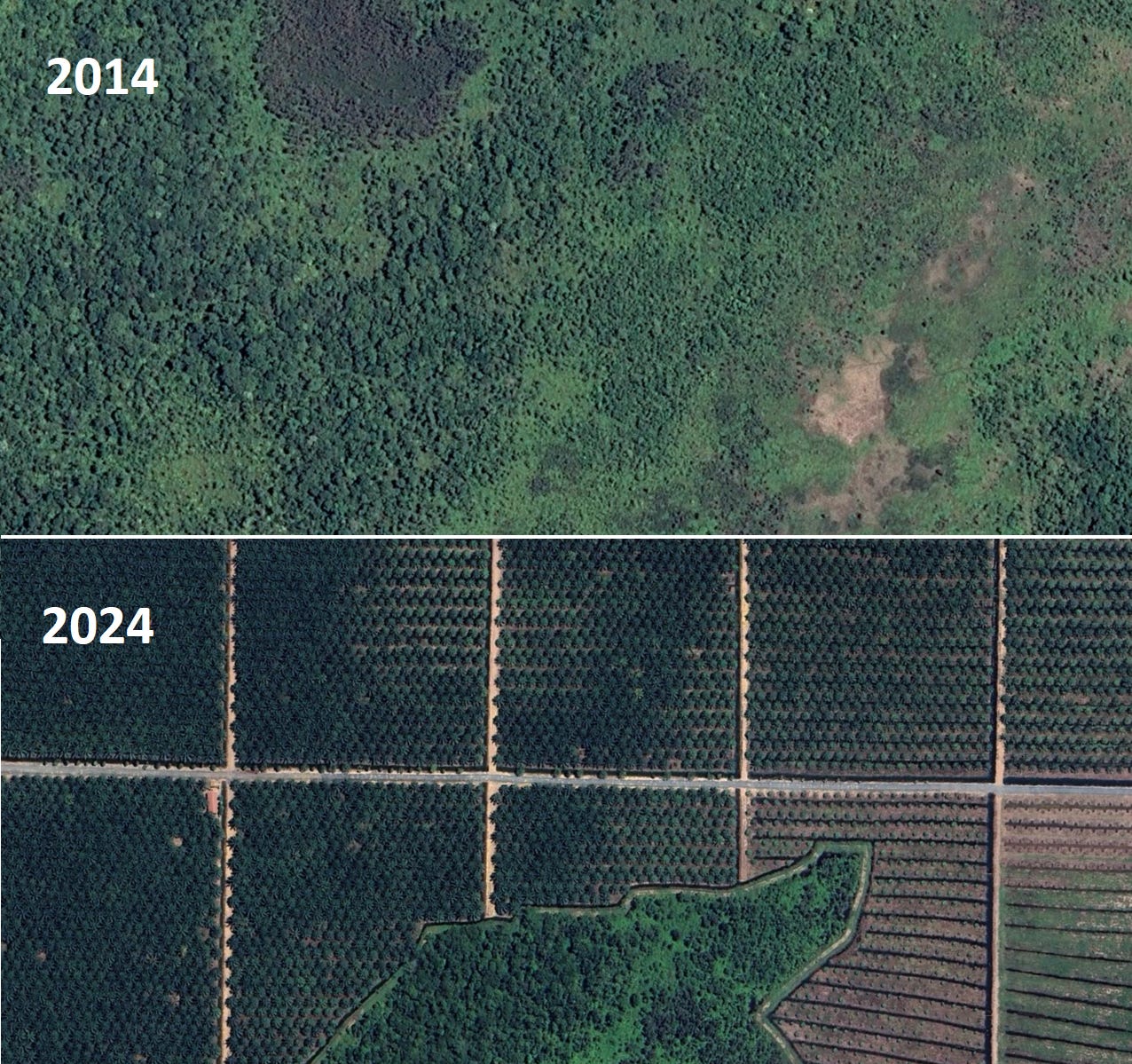
Diesel made from vegetable oils has grown rapidly around the world as a substitute for petroleum. It used about 17% of global vegetable oil in 2023, up from 1% in 2000. In California, 70% of diesel is now bio-based, much of it produced from vegetable oils.
Biomass-based diesel costs about $2 per gallon more than petroleum diesel. Governments subsidize it on the belief that it has lower greenhouse gas emissions than petroleum. In a new research paper, Tzu-Hui Chen, Rich Sexton, and I show that biofuels derived from vegetable oils have likely increased, rather than reduced, global emissions.
Interlude: The lead author on this paper, Tzu-Hui Chen, is a PhD student at UC Davis. She is currently on the job market and is AMAZING. If you’re hiring an agricultural or environmental economist, I implore you take a close look at her application!
Where is this vegetable oil coming from?
Most vegetable oils are extracted from soybeans, canola, sunflowers, or palm. We use them to fry food and as ingredients in baked goods and salad dressings.

Some of the vegetable oil used in biofuel comes from other users cutting back and some comes from increased production. The contribution of each source depends on elasticities, which are among the most useful numbers in economics. Elasticities tell us how willing consumers are to fry less food and how easily can farmers scale up production.
It really maters how much of the vegetable oil for biofuels comes from new production. Palm oil is the most widely used vegetable oil worldwide and is mostly produced in Indonesia and Malaysia. Expanding production in that region usually means clearing carbon-rich tropical forests. Converting forest to cropland causes the carbon in the forest to be lost to the atmosphere, offsetting the emissions benefit of reducing petroleum use.
This figure below summarizes our paper. It is a simple story: more demand for vegetable oil pushes up the price, which incentivizes people to convert forests in Indonesia and Malaysia to palm plantations. Unlike most previous work on this topic, which is based on theoretical computer models, we analyze data on what has actually happened over the last couple of decades.
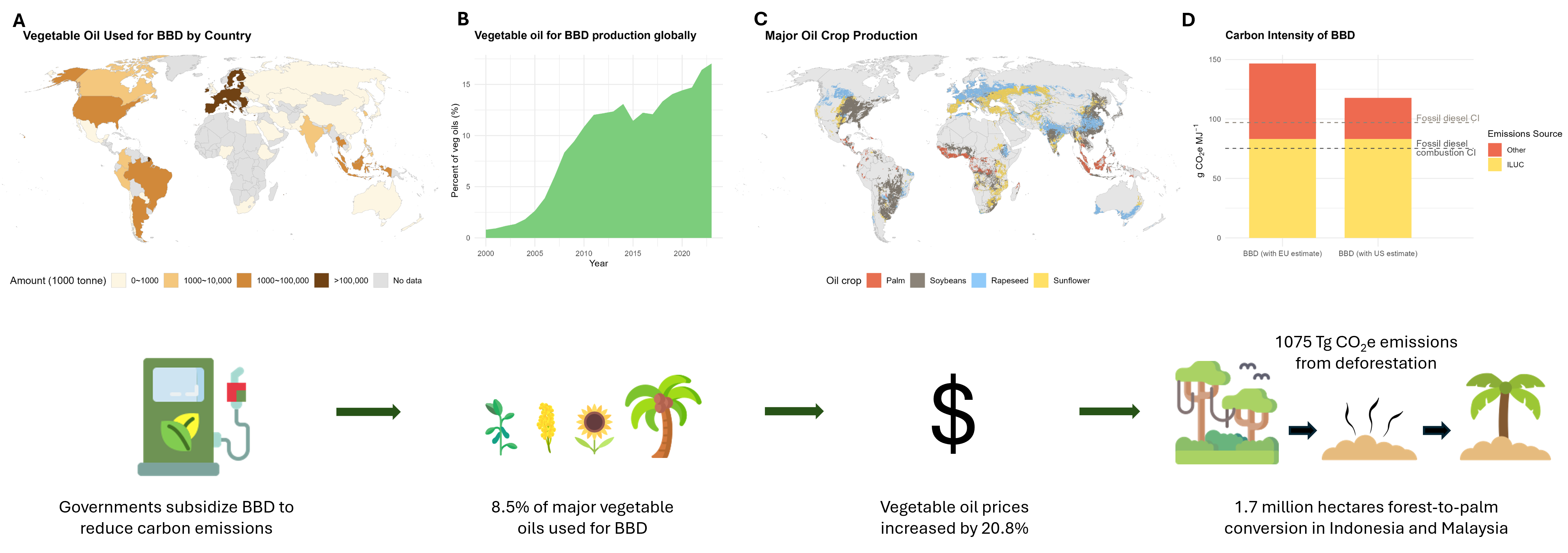
Let me walk you through the steps in our analysis.
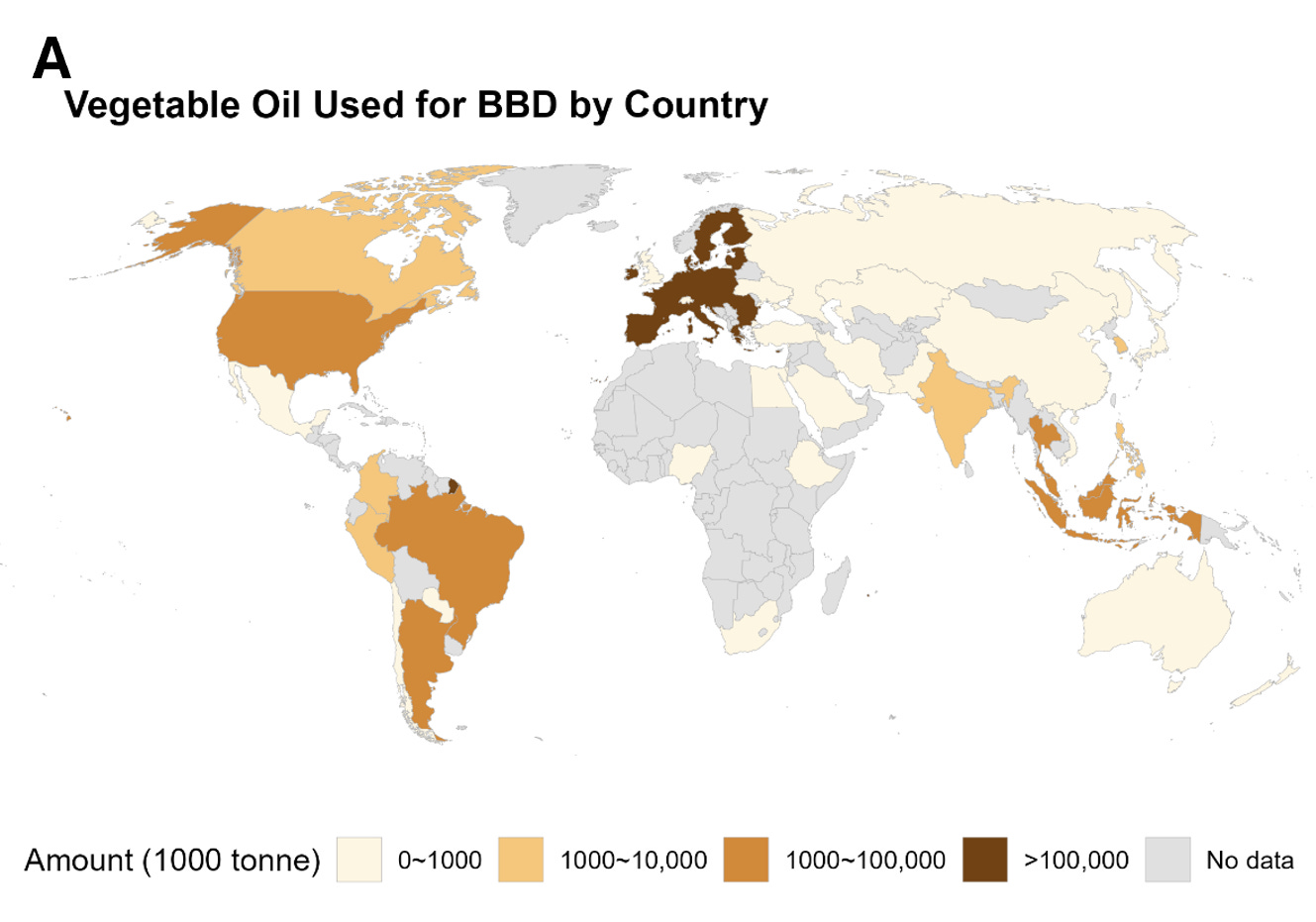
First, this is not just a California or a United States thing. Canada’s clean fuel regulations are bringing vegetable oil diesel into the system. Biomass-based diesel (BBD) is also expanding quickly in Europe, South America, and parts of Asia.
Second, between 2002 and 2018 about 8.5% of the four major vegetable oils were used to make diesel. There were rapid increases between 2005 and 2010 and again in the last few years.

Third, and this is really important, the four major oils are pretty much interchangeable. Their prices move up and down together. This means that, if the US uses more soybean oil for biofuel (as we have done), then we will import palm and canola oils to use in the food system (as we have done.) Policy makers should treat the four oils as one product.
We estimate elasticities of demand and supply for vegetable oils. These elasticities imply that using 8.5% of vegetable oil for biofuel caused palm oil prices to increase by 20.8%.

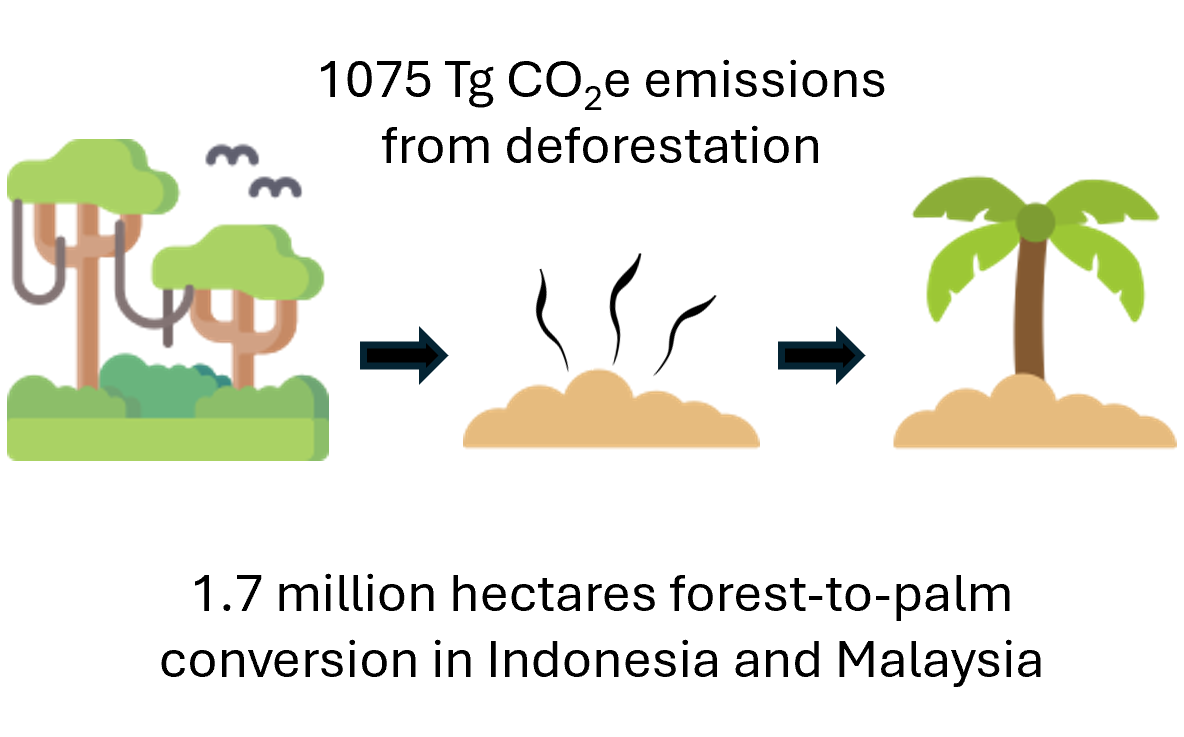
Fourth, we use satellite data from 32,305 sites in Indonesia and Malaysia to measure deforestation. Each site measures 9km × 9km. We show that, when the price of palm goes up, more of these sites are converted from forest to palm. Specifically, the 20.8% increase in the palm oil price caused 1.7 million hectares to be converted from forest to palm between 2002 and 2018. This accounts for 20% of the deforestation that occurred in that region during that period.
Because we observe where the deforestation occurs, we can use existing carbon maps to calculate the amount of lost carbon from deforesting those 1.7 million hectares, accounting for above- and below-ground biomass carbon, peat decomposition, non-peat soil carbon, and the carbon sequestered by oil palm.
We find 1,075 Tg of CO₂ emissions from this deforestation, amortized over 25 years, which is comparable to adding about 9 million cars to the road for those 25 years.
To put this emissions number in context, we present it relative to the fuel energy produced from vegetable oil and compare it to the emissions from petroleum diesel.
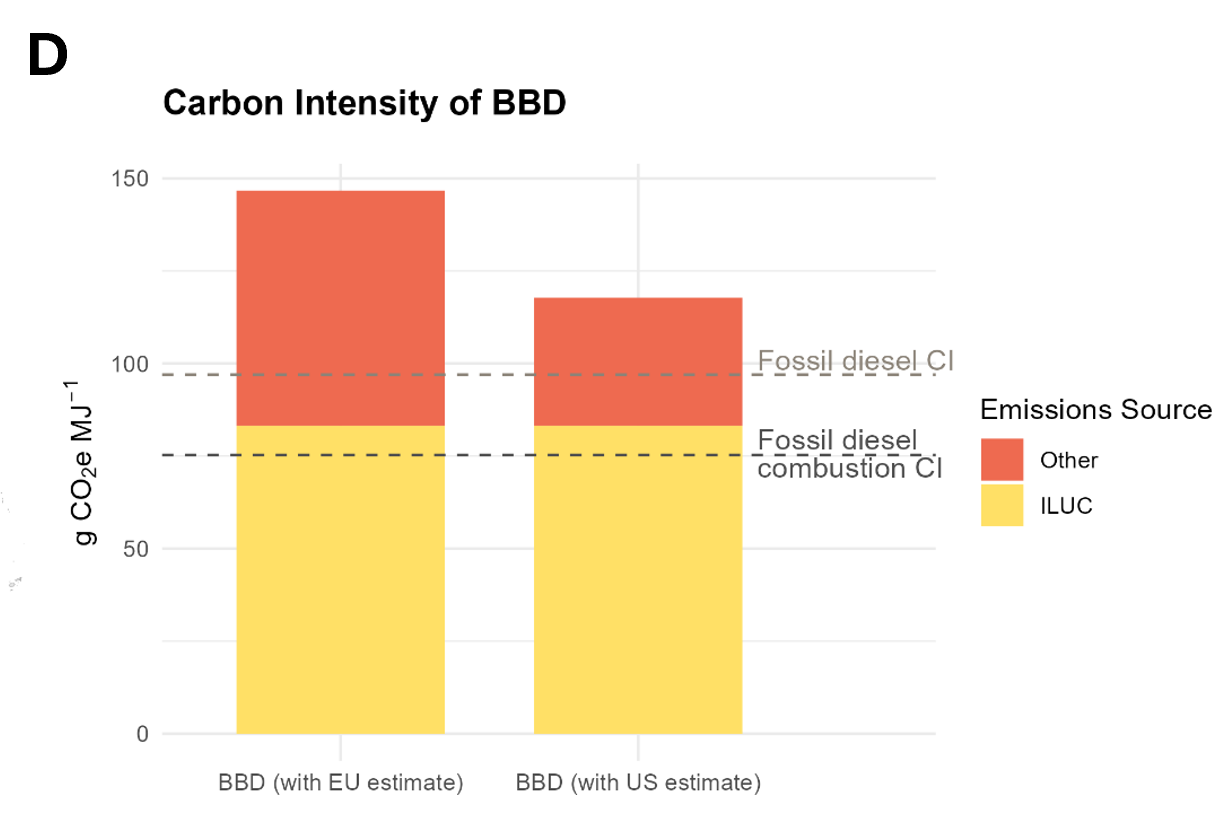
Our study shows that each megajoule of energy from vegetable oil biofuel caused 83 grams of carbon dioxide emissions just from the induced deforestation in Indonesia and Malaysia. Add the emissions from cultivation, fertilizer use, processing, transport, and distribution and you get between 118 and 147 grams per megajoule. And we haven’t even considered emissions from land use change in other parts of the world.
For comparison, petroleum diesel emits 97 grams per megajoule over its complete life cycle. In short, biofuel from vegetable oils is worse than petroleum diesel for carbon emissions.
It is time to pump the brakes on biofuels from crop-based vegetable oils. The data show that these fuels make the climate worse, not better.
Citation and link to paper: Using Vegetable Oils for Biofuel Accelerates Tropical Deforestation and Increases Carbon Emissions. Chen, T. J., Sexton, R. J., & Smith, A. Working Paper. 2025.
Postscript: Two other stellar economists I have worked with are on the PhD job market this year. Shuo Yu is graduating from UC Berkeley and Mengying (Mandy) Wu is currently a postdoc at Harvard. If you’re hiring in agricultural or environmental economists, go look at their files right now. I’m sure you will be impressed.
www.predictability-api.com