
Teaching Large College Classes in the Age of AI

The old days, nostalgically: Professor stands at the front of the room and talks while writing feverishly on the chalkboard. Riveted students take detailed notes and ask incisive questions. If they have to miss class, they borrow a friend’s notes and transcribe them so as to keep up with the material.
Nowadays, dystopically: Professor stands at the front of a dimly lit room and talks through slides projected onto a giant screen, occasionally writing on a whiteboard with pens that don’t work. A small number of students stare blankly at their laptops or phones. Most of the class didn’t show up. They told themselves they would download the slides and watch a recording of the lecture later, but they probably won’t because ChatGPT will do their homework anyway.
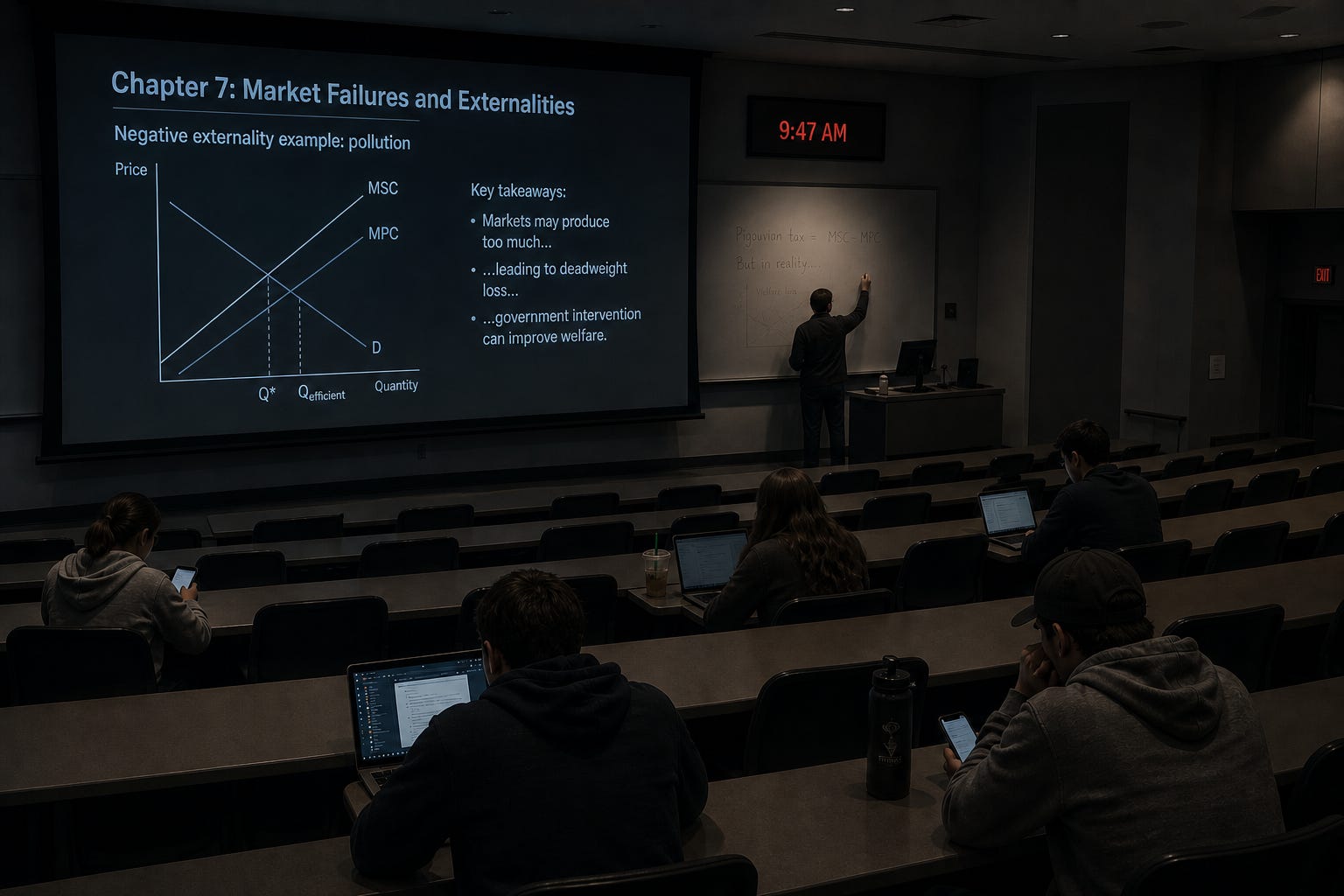
In reality, things aren’t quite that dystopian, and the old days weren’t quite that good. However, because of AI, college professors can no longer ignore the fact that our traditional modes of teaching don’t work very well. It has always been possible for students to zone out during class or get someone else to do their homework. AI just makes it a whole lot easier.
I believe we owe it to students, their families, and taxpayers to adapt. I am not writing this post because I have figured it out. Far from it. However, I wanted to share a few things I tried this semester and some thoughts about how well I think they worked.
This semester I taught Agricultural and Environmental Policy to a class of 156 mostly juniors and seniors (syllabus). My goal was to help them learn to analyze big issues in agriculture and the environment through an economics lens. I wanted them to get excited about the topics. I wanted them to engage their brains and work their analytical muscles. I really enjoyed teaching the class.
Thinking and doing
If I only assign tasks that students can easily get an AI to do for them, then I am preparing them to be replaced by AI. Why would an employer pay them to do a set of tasks that AI can do? I believe the ability to think deeply about how to define and analyze important problems is a skill that transcends the robots and equips people to adapt as the world changes.
I assume most of the students use AI tools in my class. Rather than a negative goal (prevent them from using AI), I have positive goals for the students (help them get excited to think deeply and to analyze problems) .
To these ends, I gave two writing assignments: a 600-800 word blog and a 2000-2500 word paper. I was anxious about whether this would work. How do you help 156 people do substantive work on a topic of their choice?
In this article, I describe how I set up the paper assignment. The blog was similar (with fewer steps). You can read my two favorite blog submissions here and here.
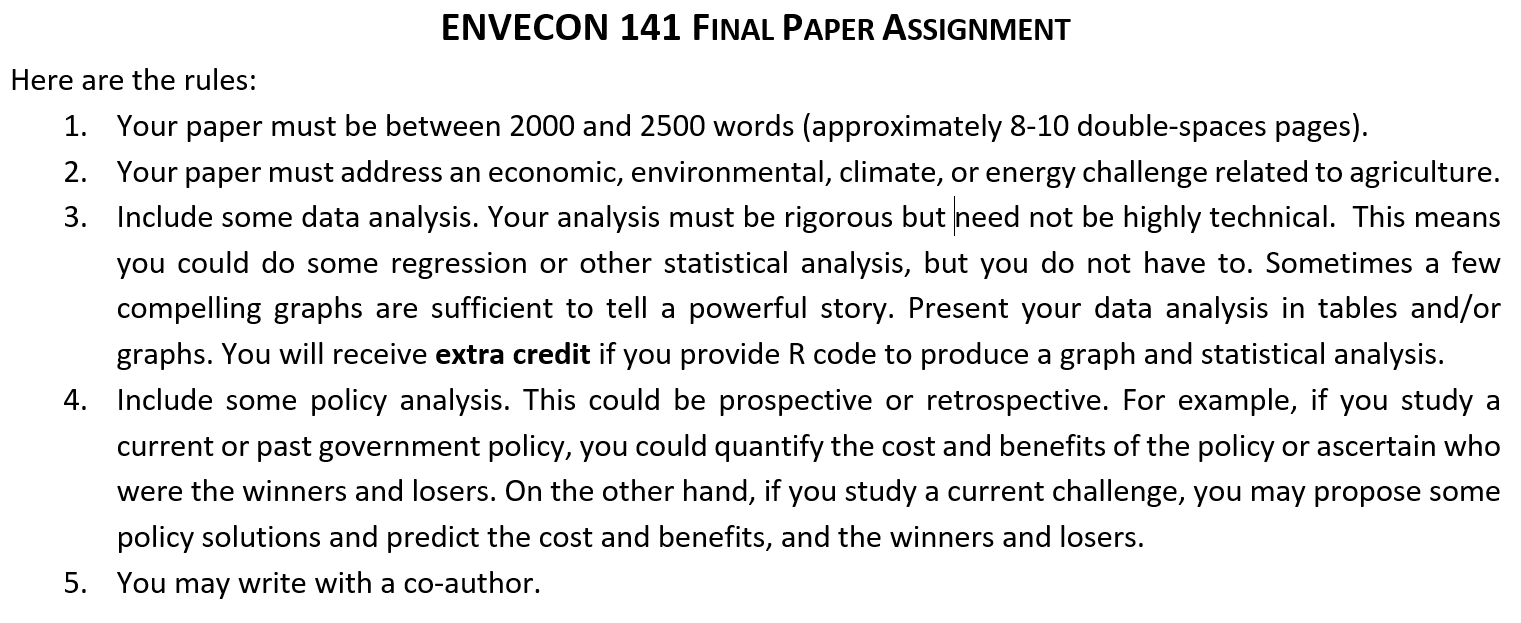
To inspire students to think deeply about a topic and analyze it critically, I had two strategies: (i) get them to talk about their topic, and (ii) give critical feedback. I think we had some good ways of achieving (i). I’m trying to figure out better ways to do (ii) in a class of this size.
I set up multiple intermediate deadlines in the assignment. Without these deadlines, it would be easy to procrastinate; you can’t study any topic deeply if you are rushing to do it at the last minute.
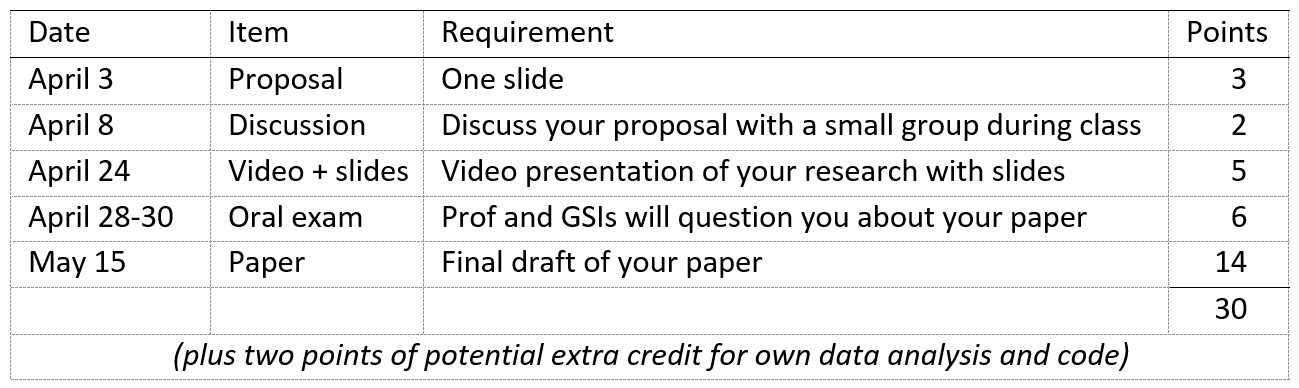
I allowed the students to work with a co-author on their paper, but each student had to do the oral components of the assignment individually.
First, the students submitted a proposal in the form of a single presentation slide containing their research question, why it is important or interesting, and how they plan to answer it.
A few days later during class, we divided the students into groups of five and had them each present to the other members of the group. They were to talk for no more than one minute and their groupmates were to question them for an additional two minutes. I suggested some questions they could ask, such as “What data will you use?”, “Do you have the data already?”, “Can you give a specific example?”, and “Why should we care?”. I used a timer so that each round lasted the specified time.
I think the first two steps worked well to get them started.
The next major steps also involved talking about their work, this time in the form of (i) a 5-minute video presentation, and (ii) an oral exam.
The oral exams required surgical precision. We devoted the entire last week of class to them (both lecture and section). I assigned each student an exam time — one every two minutes.
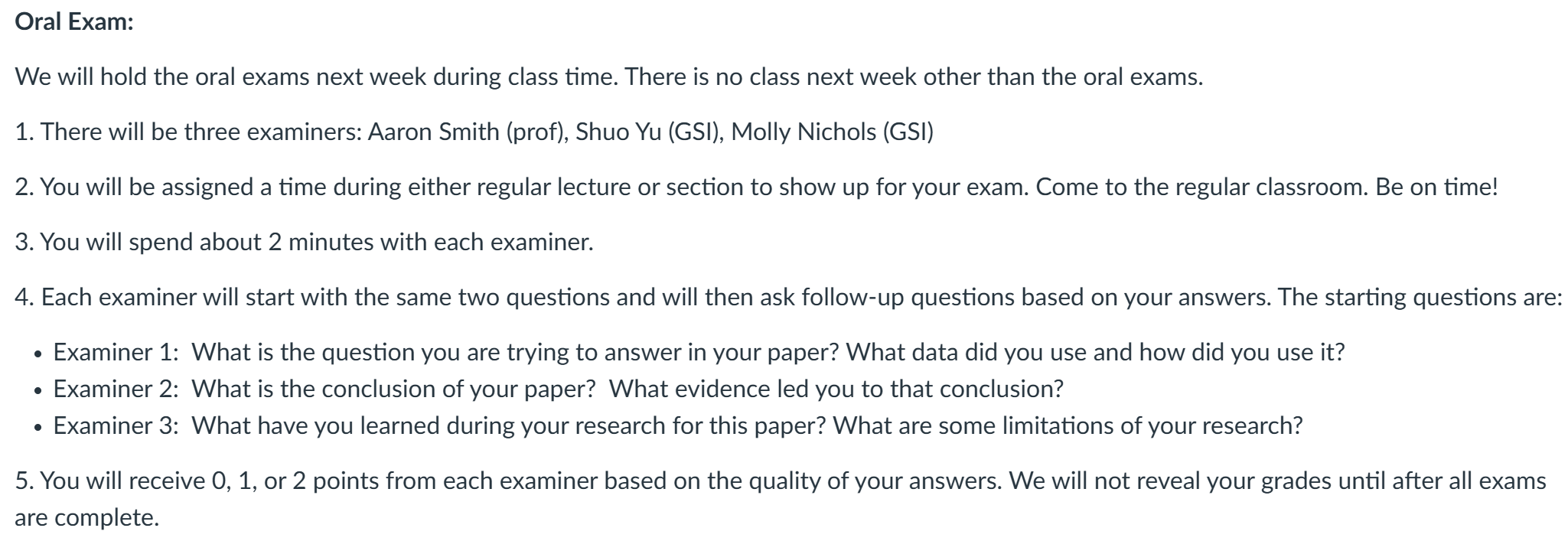
On the exam days, the three examiners (me and my two amazing graduate student assistants, Shuo and Molly) set up in three separate corners of the classroom. Students would spend two minutes talking to the first examiner, then move to the second, and then the third. One minute and 40 seconds into every exam, a timer buzzed, signaling that it was time to move to the next station.
Each examiner had a designated topic to cover, as shown in the above screenshot. We graded the students on the spot, but didn’t reveal the grades until later. We had formulated student-specific questions based on their video presentation, but rarely got the opportunity to ask them before time ran out. We did share those questions and comments with each student later to help them improve their paper.
In spite of the timer, we inevitably fell behind. In several cases, the last couple of students were finishing their exams as the next class was filing in. Not ideal, but we got it done.
For me, the exams were a lot of fun. Before the exams, I had only spoken one-on-one with a small minority of students. It was great to meet them all. I really enjoyed hearing how excited many of them were about their research topic.
The students are now finishing up writing their papers, which are due at the end of this week. Here’s a word cloud of the topics they chose.

The most glaring deficiency in this assignment is the amount of critical feedback we provided. I would like to modify the oral exams to allow time for the examiners to give immediate feedback. Ideally, we would deliver the feedback in oral and written form (e.g., could an AI record what we say and email it to the students? ). We could make students accountable for responding to the feedback.
I think we also need to require the students to submit a draft paper that we provide feedback on. The 5-minute video presentation and 6-minute oral exam allowed us to push the students on their basic arguments, but refining the details requires more time.
I wonder whether it would be possible to train an AI to do this effectively — at least on the structure and quality of the arguments. And, yes, I get the irony of working hard to get students to invest time and effort into a project while I work hard to get AI to reduce my time and effort. This is the challenge of scaling labor-intensive teaching to large classes.
Finally, I’m sure there are ways to improve the grading rubric.
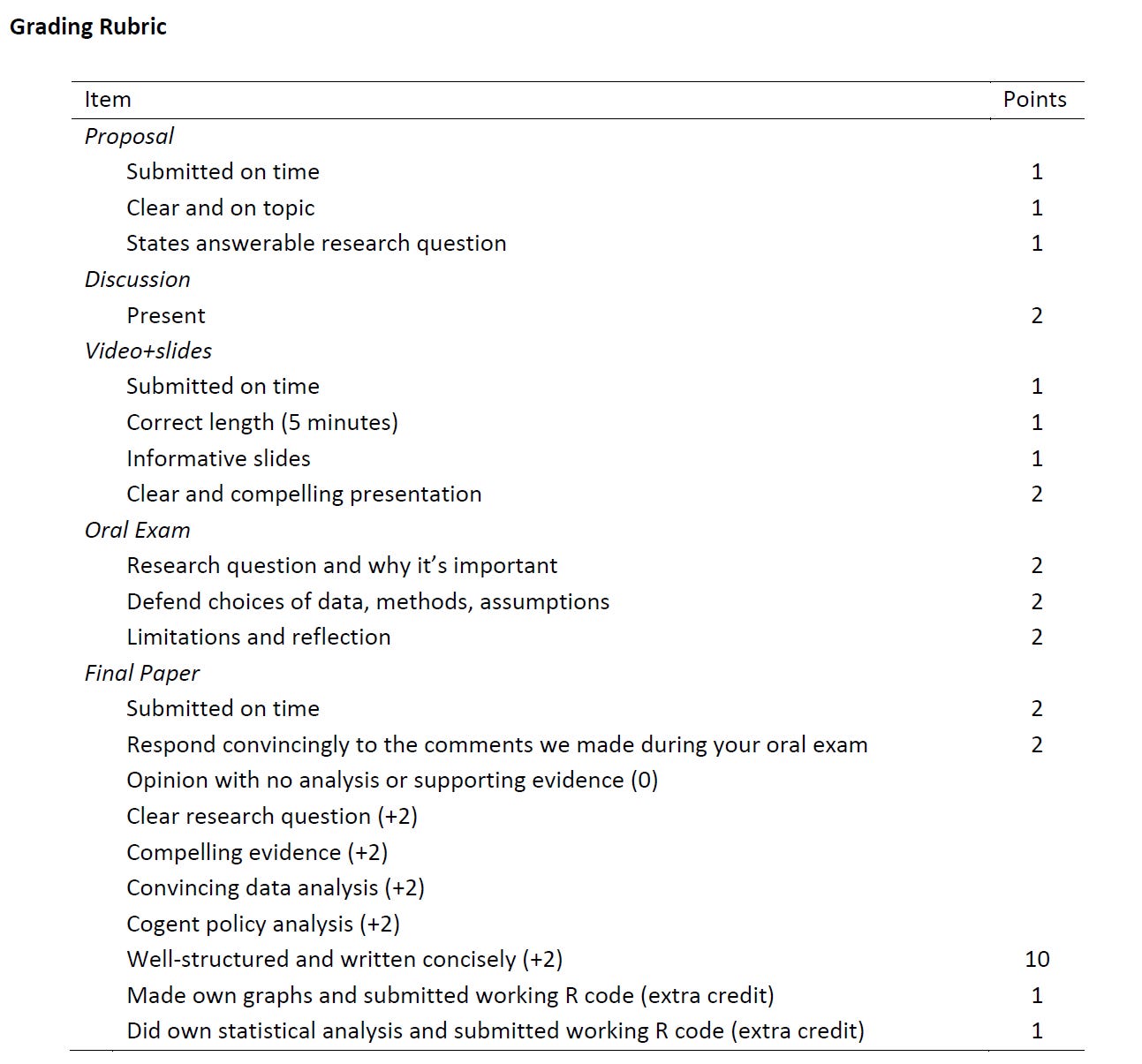
In the future, I may write about other aspects of the class, such as the required weekly reading assignments, the in-class trading games Claude helped me code, giving credit for class participation using iClicker and Google forms, the in-class written exam, and the econometric replication projects in discussion section.
I hope this post provides an interesting window into the classroom. Please add comments with ideas, reactions, and suggestions. This is an exciting time to be a college professor.
Super cool! Thanks for sharing.
Hi, I'm one of the 156 students in your class! I honestly loved this class so much because it never really felt like a lecture. It felt like actually getting to learn and be curious. As a premed student, most of my classes are super intense, so it would’ve been really easy for me to push agriculture to the side, but this class made me genuinely want to pay attention and learn more. I always left class feeling interested instead of drained, which is rare, honestly. Thank you for creating such an engaging and welcoming learning environment :)