
Engineering vs Economics
Further analysis of the effects of subsidizing vegetable oils for aviation fuel in California


An engineer can build you a new mousetrap. Just give them the specs and they will design it and make sure it works.
An economist can tell you how many new mousetraps you will be able to sell.
OK, that’s promising too much. Economists can’t tell you exactly how many you will sell, but they can explain how prices, government policy, and market structure will determine outcomes. For example,
If your new mousetraps cost more than old mousetraps, then you will only be able to sell them if people like them better than old mousetraps.
If your new mousetraps cost more than old mousetraps and work just as well, but the government gives you a subsidy so you can sell them at a competitive price, then people may buy your mousetraps instead of old mousetraps.
If your region imports mousetraps and then you start producing mousetraps locally, the price of mousetraps won’t materially change. Global supply and demand determine the price and your production is too small to materially affect that price.
Why am I analogizing with mousetraps? It’s my latest attempt to explain the potential effects of California’s proposed tax credit for biofuel in airplanes, known as sustainable aviation fuel (SAF).
In case you missed the previous editions, the California governor has proposed a subsidy for using SAF. My co-authors and I pointed out the likely unintended consequences, including a large loss of road-repair funds and an increase in fuel prices at the pump. We also showed that the environmental benefits would be small. Advocates for the policy claimed that we had made some errors. I explained that our analysis was sound.
The latest contribution to the discourse is a piece by Harold “Skip” York of the Baker Institute for Public Policy and the Sustainable Aviation Advisory Council. York describes how (i) biofuel refineries that produce SAF also produce by-products that could be used in gasoline, (ii) if crude oil refineries produced less jet fuel, they could produce more gasoline, and (iii) with more in-state SAF production, ships that had been carrying imported jet fuel could instead carry imported gasoline.
He projects that, if the Phillips 66 refinery in Rodeo California were to produce SAF, then these three factors could cause California gasoline prices to decline by 20-40 cents per gallon!
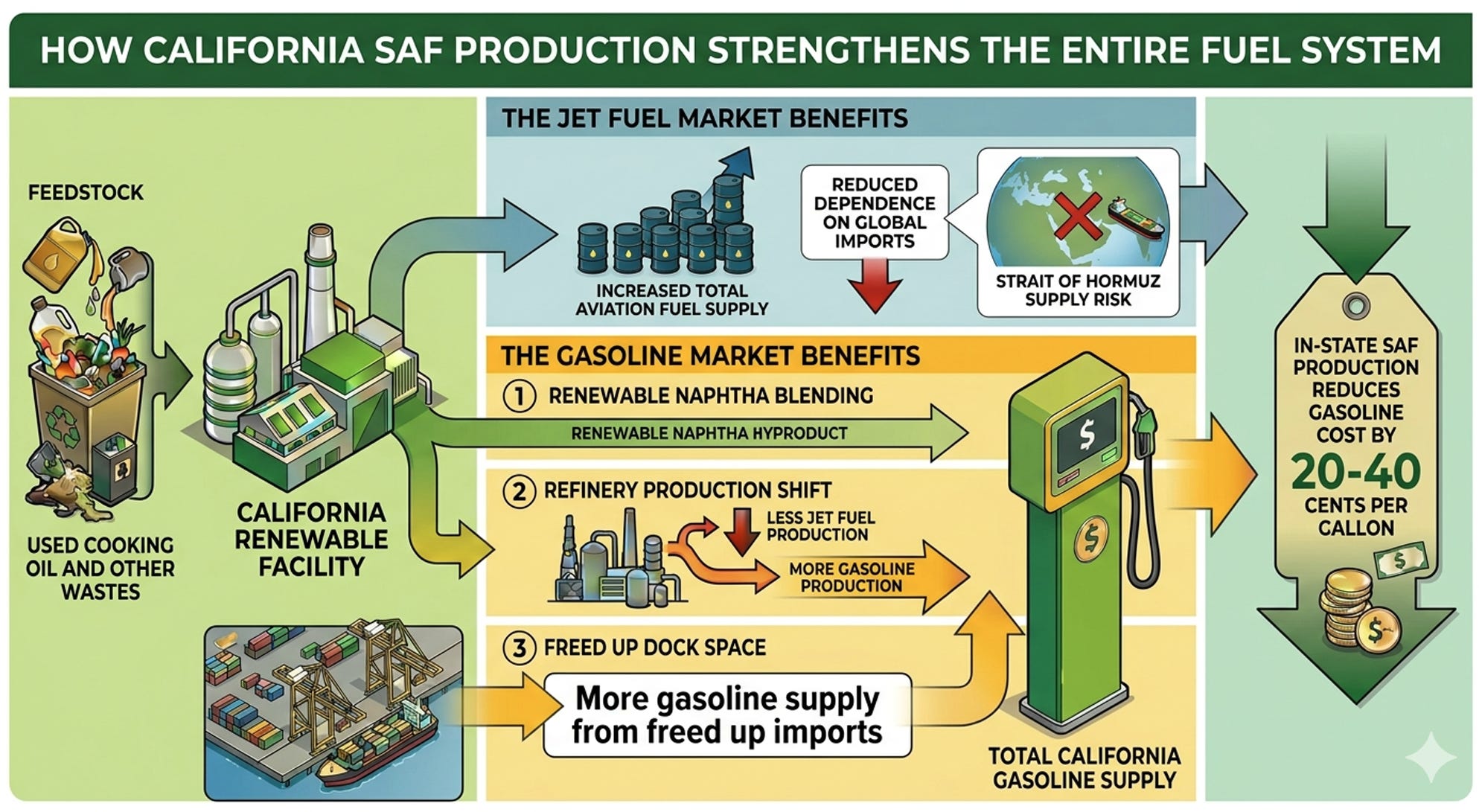
Assuming it’s correct, this engineering analysis demonstrates three things that could happen, but whether they will happen depends on the economics.
Here’s my economic analysis:
Biofuels such as renewable diesel (RD) and SAF are much more expensive than their fossil fuel counterparts. They are also essentially identical to their fossil counterparts. Some airlines may buy a little SAF for green marketing purposes, but generally people will not buy these products of their own volition (see mousetrap item #1 above).
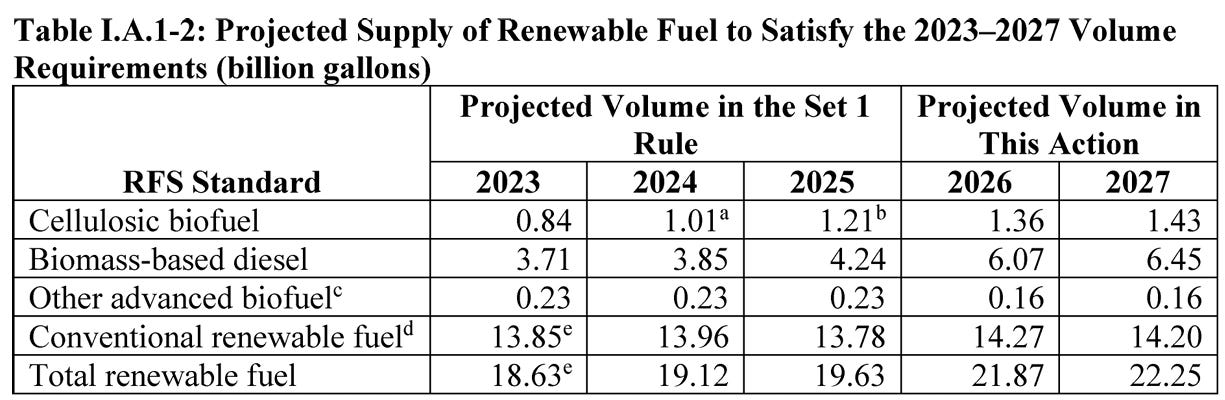
If government subsidies bring RD and SAF prices to parity with their fossil counterparts, then people will buy them. Federal policy subsidizes a specified volume of RD+SAF (see the table below). If you make SAF relatively more attractive, then people will buy less RD (see mousetrap item #2 above).
California imports gasoline and jet fuel now. It would still import gasoline and jet fuel if Phillips 66 produced SAF at full capacity, so it would still be subject to world market prices. Producing a little more gasoline in the state would not reduce the price of the marginal gallon used in the state (see mousetrap item #3 above).
There are valid reasons to subsidize SAF. If we believe that, by producing SAF, the industry will figure out how to dramatically reduce costs, then there’s value to subsidizing SAF now. This is the story of solar and batteries.
I’m somewhat skeptical that this argument applies to vegetable-oil based SAF because the big cost driver is the vegetable oil. SAF costs are high because vegetable oil is too expensive, rather than because refineries haven’t yet figured out how to cheaply turn vegetable oil into fuel. For example, the current price of soybean oil is 75c/lb and you need 9 pounds to make a gallon of SAF, so you’re up to $6.75 per gallon even before accounting for production costs. Jet fuel currently trades for $4, up from $2 before the Iran war.
Societies can also choose to subsidize a company or a production facility to help the workers or owners of that facility. If drivers and taxpayers in the state of California want to pay a biofuel refinery to produce expensive airplane fuel, then they can do that. But, I think it’s important to be clear-eyed about the costs, benefits, and potential unintended consequences of any such policy.
Snap, Aaron. I appreciate the mouse trap analogy. Thank you.